
5 RevRec Edge Cases Controllers Face in 2026 (And the Fixes That Actually Work)
ASC 606 was designed for a simpler world. A customer signs a contract, receives a service, and you recognize revenue over the period. Clean, linear, predictable.
That world is increasingly rare.
The shift to usage-based, hybrid, and multi-element pricing has created scenarios that the standard does not handle cleanly on its own. Consumption-based overages, prepaid credit drawdowns, mid-contract upsells, and multi-entity billing structures each require judgment. And judgment, without documentation, creates audit risk.
Three things make revenue recognition edge cases especially dangerous. First, they are infrequent enough that most finance teams have no standing policy for them. Second, they require a cross-functional context of what sales promised, what legal agreed to, and what the product actually delivered. Third, getting the treatment wrong can require restatement.
Revenue recognition errors are the number one reason for financial restatements among SaaS companies. As pricing models grow more complex, the window for judgment errors widens.
Jill Hauck, Controller, 12th & Norwegian, said that most RevRec edge cases could be incorrect because there was no policy, and someone made a judgment call under pressure. (from Zenskar's RevRec Edge Cases webinar, 2025)
According to OpenView Partners, 61% of SaaS companies now use some form of usage-based pricing element. That means edge cases are no longer exceptions. They are your standard operating environment.
The following five cases are the ones often flagged as highest-risk in practice.
Case 1: Parent-child contract structures: billing one entity, recognizing for many
The scenario
A parent company signs and pays the master contract. Usage, however, is distributed across subsidiary entities, each with its own cost center, legal entity, or reporting requirement. Parent-child billing as per ASC 606 is required.
Why is it hard?
Your billing system invoices the parent. Your revenue recognition obligation, though, belongs to the subsidiaries where consumption actually occurs. If billing and RevRec are coupled in your system, you will either recognize revenue at the wrong entity or force manual reconciliation every close.
The common mistake
Treating the billing entity and the recognition entity as the same. This creates intercompany allocation errors and misrepresents revenue by legal entity, which matters the moment you consolidate financials or face a subsidiary-level audit.
The right treatment
Decouple billing from revenue recognition entirely. The parent entity is the contracting party. Revenue must be allocated to the subsidiaries based on actual usage or an agreed-upon allocation methodology. This requires your RevRec system to understand hierarchical contract structures, not just invoice-level relationships.
This decoupling is an architecture decision, not a configuration option. Zenskar’s billing engine and revenue recognition engine run independently. Billing happens at the contract level, RevRec happens at the obligation level, and parent-child structures are modeled natively in the graphical data model.
What makes this work
A hierarchical billing architecture where parent-child contract relationships are modeled explicitly, and revenue recognition runs independently of the invoicing layer. If your system can only recognize revenue where it bills, you will be building workarounds every quarter.
Case 2: ASC 606 contract modification vs free add-on: when it matters
The scenario
A customer is mid-contract. Your sales team offers them a free feature module as a goodwill gesture or competitive retention play. No additional charge. Just add it to the account.
Why is it hard?
Under ASC 606, adding a new deliverable to an existing contract triggers one of two treatments. If the new module is a distinct performance obligation, you must allocate the standalone selling price (SSP) to it and potentially adjust revenue recognized in prior periods. If it is not distinct, you treat it as a contract modification and adjust prospectively.
The common mistake
Treating every free add-on as a non-event because no money changed hands. The absence of incremental consideration does not mean the absence of a performance obligation. If the add-on has independent value to the customer, ASC 606 requires you to account for it.
The right treatment
Ask two questions. First, can the customer benefit from this module on its own? Second, is it separately identifiable from the rest of the contract? If yes to both, it is a distinct performance obligation. This is common with standalone tools such as procurement analytics software that can deliver independent value outside the core platform. Allocate SSP, adjust the transaction price, and restate if the impact is material. If the add-on is not distinct (e.g., it only works in conjunction with the existing product), treat the change as a modification and apply prospectively.
Documentation requirement
Capture the sales context. Was this offered as a retention play? An error correction? A goodwill gesture? The characterization affects treatment, and auditors will ask.
Case 3: Minimum commitment revenue recognition and unused capacity: 3 ways to get it wrong
The scenario
A customer commits to $120,000 annually. They actually consume $80,000 worth of service. The $40,000 gap is real money you collected but arguably did not fully earn through delivered service.
Why is it hard
ASC 606 gives you multiple defensible treatments. That flexibility is exactly what makes this a judgment call, and judgment calls without documentation are what auditors flag.
The three treatments (and where each goes wrong):
The most common mistake is defaulting to straight-line recognition because it is easiest to implement when the contract language actually supports a different treatment. Your auditor will read the contract. You should read it first.
The auditor test
Whichever treatment you choose, you need to be able to explain (1) why the contract language supports that treatment, (2) what happened to the unused capacity, and (3) whether your policy is applied consistently across all contracts with minimum commitments. Under ASC 606, this unused capacity should be evaluated as breakage, where expected breakage is recognized proportionally to the pattern of customer usage.
Zenskar uses a graphical data model where contracts are mapped as objects on a graph covering every amendment, pricing dimension, and usage tier. This is the architectural reason Zenskar handles edge cases without workarounds.
Case 4: Upsell at similar discount: new contract or modification?
The scenario
An existing customer wants to add seats six months into their annual contract. Your sales team offers the same percentage discount they received on the original deal. Seems straightforward, but it is not. Variable consideration, as per ASC 606, needs to be assessed.
Why is it hard?
The ASC 606 section on contract modification draws a specific line. If the new seats are priced at their standalone selling price (SSP), treat the addition as a new, separate contract. If the pricing reflects a discount not consistent with SSP, it is a modification of the existing contract. The distinction matters because these two paths have different accounting outcomes.
New contract treatment
Recognize the new seats prospectively. No impact on the existing contract's recognized revenue.
Modification treatment
Apply either a cumulative catch-up (if the remaining performance obligations are distinct) or a prospective adjustment (if they are not). This can affect the revenue you have already recognized.
The common mistake
Assuming that because the discount percentage is the same, the price reflects SSP. SSP is not a percentage; it is a dollar amount tied to the actual value of the performance obligation. If your SSP for seats has shifted since the original deal (due to pricing changes, market conditions, or promotional activity), the same discount percentage may or may not equal SSP.
The documentation requirement
Maintain a current SSP range for every performance obligation. When an upsell closes, compare the deal price against the current SSP range. If it falls within range, document it as a new contract. If it falls outside, document the modification rationale. This takes minutes at deal close and saves hours at audit.
Case 5: Seat additions and API overages: separate decisions or one deal?
The scenario
A customer adds seats mid-quarter. Simultaneously, their API usage spikes beyond their contracted tier, generating overages. Both show up in your billing system. Do you recognize them the same way?
Why is it hard?
Under ASC 606, these are two fundamentally different purchasing events. Seat additions are a contract modification or new contract (see Case 4 above). API overages are a variable consideration event, recognized in the period the usage is consumed.
The common mistake
Bundling seat additions and overages into the same recognition treatment because they both show up on the same invoice. The invoice is a billing artifact. Revenue recognition follows economic substance, not invoice structure.
The right treatment for overages
Overages recognized on consumption in the period the API calls were made, not the period you invoice for them. This requires real-time usage data flowing from your product infrastructure into your RevRec system. If there is a lag between usage and recognition, you will have timing errors at every close.
Zenskar’s deterministic recognition engine leverages computations that run on rule-based logic, so AI never touches the numbers.
The infrastructure requirement
Real-time usage data pipelines are not a nice-to-have for this treatment. If your RevRec system only ingests usage data at billing time, your overage recognition will always be a period behind. This is a system design problem, not an accounting policy problem.
The RevRec edge case decision framework
Every edge case above follows the same decision logic. Before you choose a treatment, answer these questions:
- Has the scope of the contract changed, or only the price?
- If the scope changed, is the new deliverable distinct from existing obligations?
- If distinct and priced at SSP, treat as a new contract.
- If distinct but not at SSP, treat as a modification.
- If not distinct, adjust remaining performance obligations prospectively.
- Document the contractual basis for the treatment. Document your SSP range. Document consistency with prior treatments.
The documentation trail is not optional. It is what converts a judgment call into a defensible accounting position.
How Zenskar handles these edge cases without the spreadsheet
The five cases above are solvable with good policy and disciplined documentation. The problem is that at 50+ contracts, the manual process breaks down. Policy documentation gets inconsistent. Usage data arrives late. Modifications get misclassified because the sales team did not flag them.
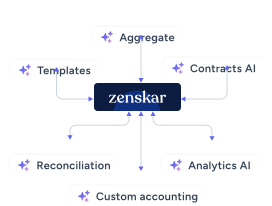
Zenskar extracts performance obligations directly from contract language. It identifies modification events, flags minimum commitment structures, and classifies new additions against your SSP ranges automatically.
The revenue recognition engine runs independently of the billing layer. That decoupling is what makes parent-child structures, overage recognition, and modification accounting tractable at scale. Billing happens at the contract level. RevRec happens at the obligation level. They are not the same thing, and Zenskar does not force you to treat them as if they were.
Every edge case in this guide is handled in the platform. No workarounds. No spreadsheet overlays. No manual true-ups at close.
Book a demo and see how Zenskar handles all 5 edge cases automatically.
We launched our product 4 months faster by switching to Zenskar instead of building an in-house billing and RevRec system.

Frequently asked questions
An ASC 606 edge case is a revenue recognition scenario without a single clear rule. It requires documented judgment, often involving contract modifications, variable consideration, or complex pricing structures common in SaaS.
Minimum commitments can be recognized straight-line, on consumption with a true-up, or at expiry for unused capacity. The correct approach depends on contract terms and must be consistently documented and applied.
If additional goods or services are distinct and priced at a standalone selling price (SSP), it is a new contract. If not, it is a modification requiring cumulative catch-up or prospective adjustment.
API overages are variable consideration and must be recognized in the period of consumption, not invoicing. This requires accurate, real-time usage data to avoid timing errors.
Revenue must be recognized where the service is consumed, not where billing occurs. This requires allocating revenue across entities and separating billing logic from revenue recognition.
.webp)
Stay Future-Ready with AI-Native Order-to-Cash
Zenskar scales with you - it's flexible, reliable, and enterprise-ready.
