

🔖 Definition Gross revenue retention (GRR) is a metric that measures how much recurring revenue you retain from your existing customers over a given period, excluding any new revenue from upsells, cross-sells, or expansions.
Prerequisite
Monthly recurring revenue (MRR) is the predictable revenue a business can expect each month from active subscriptions.
Formula
Importance
GRR measures pure retention without the influence of upsells or add-ons. It helps you understand how much recurring revenue is retained from existing customers.- A GRR of 100% means you retained all revenue from existing customers (no downgrades or churn).
- A GRR below 100% indicates some revenue loss due to downgrades or customer exits.
- Unlike NRR, GRR never exceeds 100% because it does not include expansion.
Visualizations
GRR chart
Description
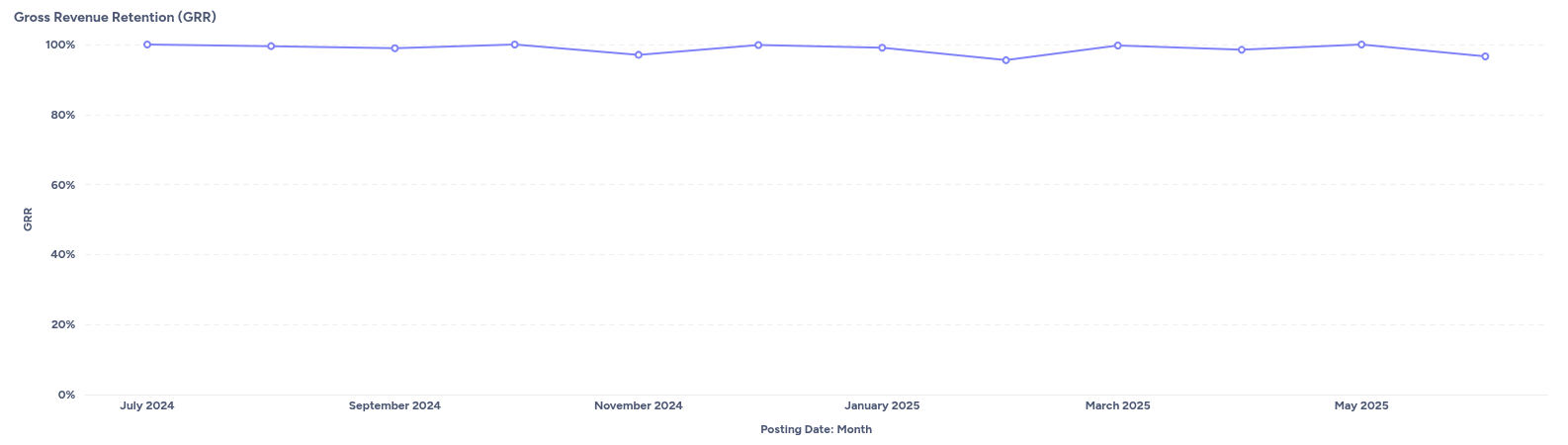
The GRR chart shows how much recurring revenue is retained from existing customers, excluding expansion revenue.Chart components
- X-axis: Each month from July 2024 to May 2025.
- Y-axis: The GRR percentage from 0% to 100%.
- Data points: Each data point represents the GRR for a given month.
Interpretation & insights
- From July to October 2024, GRR stayed close to 100%, suggesting stable customer retention.
- In December 2024 and February 2025, GRR dipped—likely due to a combination of churn or downgrades.
- The overall trend remains strong, showing consistent performance in retaining base revenue over time.
GRR table
Interpretation & insights
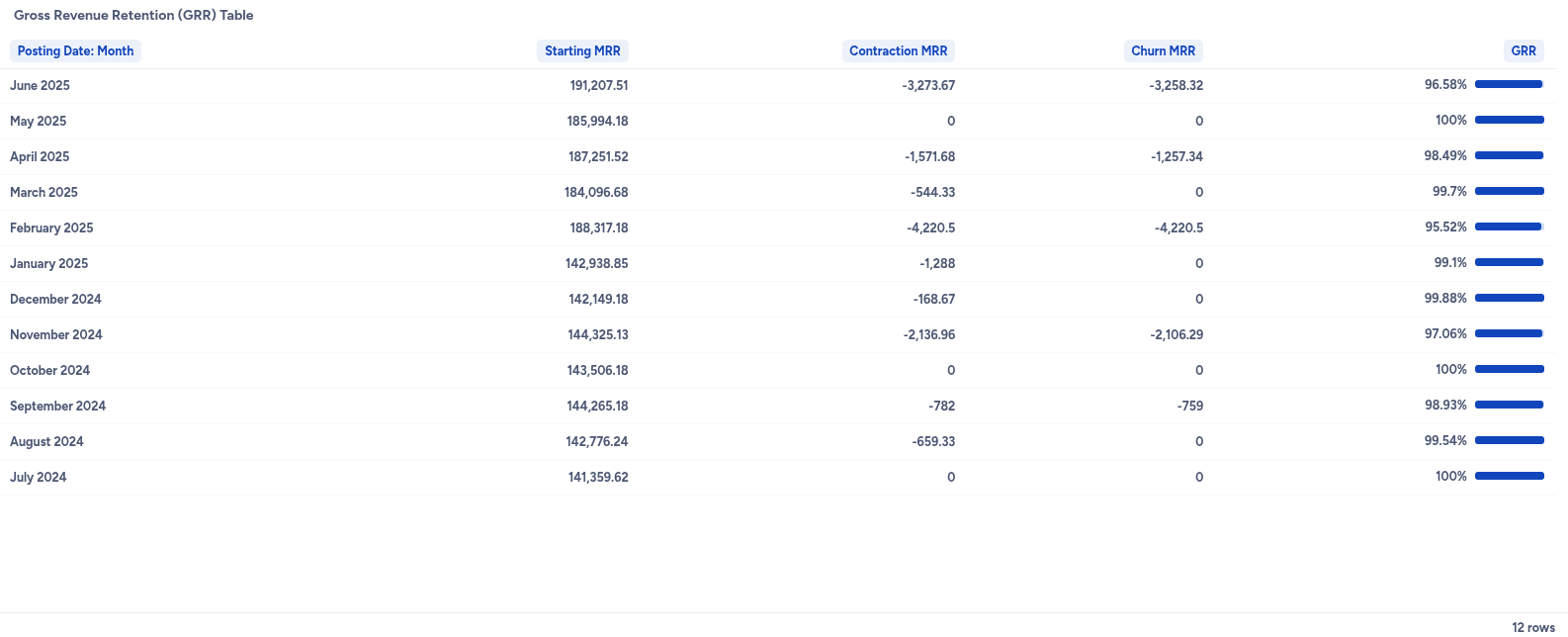
- June 2025:
- Starting MRR: $191,207.51
- Contraction: -$3,273.67
- Churn: -$3,258.32
- GRR = 96.58% → Indicates 3.42% revenue was lost from existing customers.
- May 2025:
- No contraction or churn → GRR = 100%
- February 2025:
- High churn ($4,220.5) → GRR = 95.52%, a noticeable dip in retention.
Related concepts
Use GRR alongside NRR to get a fuller picture:- GRR helps measure revenue stability.
- NRR helps measure growth from your existing base.